




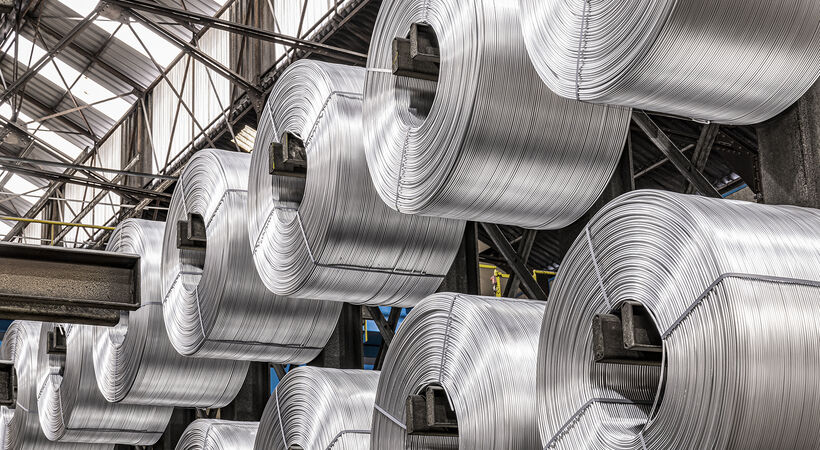
Trimet plans to expand its production of aluminium alloys for wired applications with recycled content.
This is part of the company’s strategy to continue to advance the expansion of the circular economy in the aluminium industry.
In particular, the demand for aluminium wire made with recycled content is increasing across electrical, mechanical, and welding applications.
Aluminium can be recycled indefinitely without any loss of quality, but processing is challenging, as many alloys place high demands on sorting, material separation, and process control.
Trimet has therefore established closed-loop material cycles that allow for the collection and recycling of scrap materials while ensuring a constant quality level.
The company now aims to further expand this successful model.
“By expanding the circular economy in the aluminium industry, we are not only contributing to the achievement of climate protection goals, but we are also increasing material efficiency and supply security for an important industrial material in Europe,” said Philipp Schlüter, Chairman of the Executive Board of Trimet Aluminium SE.
The closed material cycles are based on concepts tailored to the specific application and integrated into existing recycling networks.
While engaging with its customers, Trimet also relies on a network of partners specialising in scrap collection, sorting, and processing in a way that ensures the necessary material purity.
The integration with Trimet’s recycling sites in Germany enhances the stability and flexibility of these networks.
At its sites in Saint-Jean-de-Maurienne and Castelsarrasin in France, the company produces around 100,000 tons of wire rod annually for electrical, welding and mechanical applications.
Key areas of use include the energy and automotive industry, as well as other segments such as the transport sector, medical technology, and aerospace.

