




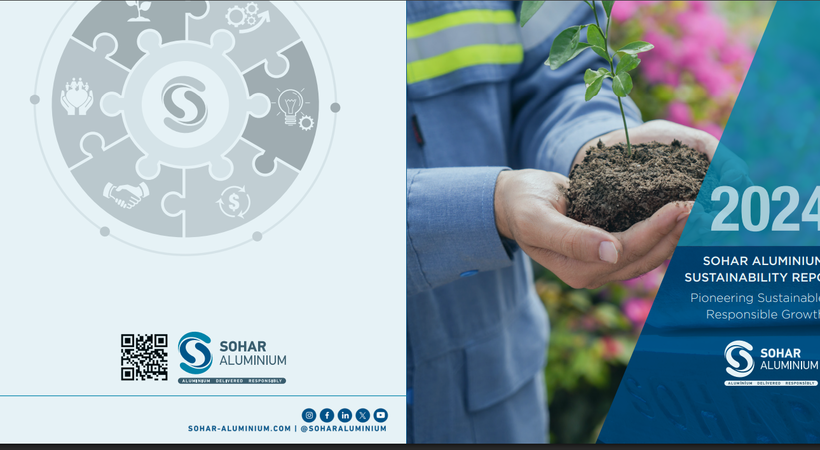
Sohar Aluminium has released its latest Sustainability Report.
The smelter founded in 2004 has a capacity to produce 390kt of aluminium a year and also has a 1000MW power plant and port facilities.
The Sohar Aluminium Sustainability Report 2024, highlights progress across key areas such as energy management, emissions control, and decarbonisation strategy.
The report said: "In 2024, we took significant steps to enhance resource efficiency, reduce our environmental footprint, and promote a more sustainable supply chain.
"Key initiatives included advancing energy efficiency projects, optimising waste management strategies, and enhancing workforce well-being through targeted engagement programmes.
"These efforts reflect our commitment to creating long-term value for our stakeholders while reinforcing operational resilience.
"Looking ahead, we remain focused on strengthening our decarbonisation strategy, integrating circular economy principles, and driving meaningful ESG progress.
"By embedding sustainability at the core of our business, Sohar Aluminium is shaping a future that is responsible, resilient, and aligned with global sustainability ambitions
The report states Sohar Aluminium predominantly relies on natural gas secured through a long-standing agreement with the Omani government.
To ensure business continuity and operational resilience, the company’s on-site power plant is also capable of switching to diesel in emergency situations.
Following the 2023 Order of Magnitude study Sohar Aluminium has implemented several energy-saving measures.
These included adjusting its operational settings of a compressed air system which led to a reduction in energy consumption, lower maintenance needs, and extended equipment lifespan.
"As a result, the initiative helped cut emissions and enhance overall system performance."
The company’s GHG emissions primarily arise from fuel combustion at its power plant and from the electrolytic smelting process, which generates carbon dioxide (CO2), perfluorocarbons (PFCs), and hydrogen fluoride.
In 2024, the company continued to employ its own GHG calculation tool, aligned with the GHG Protocol and the International Aluminium Institute’s reporting standards, to track and manage emissions.
An independent Carbon Footprint study also benchmarked the company’s emissions profile against global best practices.
The data shows that Sohar Aluminium performs competitively compared to five other smelters in the GCC region.
The company also adheres strictly to national environmental regulations.
However, total emissions intensity rose slightly in 2024 to 6.19 tonnes of CO2 per tonne of aluminium, compared to 5.51 tonnes in 2023 - a change likely driven by increased production volumes.
Despite this, the company has made progress in targeted areas.
Over the past six years, fluoride emissions were reduced by 22%, while nitrogen oxide (NOx) emissions from the power plant have steadily declined from 2021 to 2024.
Sohar Aluminium remains firmly committed to reversing any upward emissions trends and aligning its operations with Oman’s net-zero aspirations.
The company’s Decarbonisation Strategy, updated and reviewed in December 2024 with stakeholders including OQ Alternative Energy, Rio Tinto, and TAQA, lays out its roadmap.
Aligned with the International Aluminium Institute’s net-zero pathways, the plan sets progressive emissions reduction targets: 13% by 2030, 43% by 2040, and 86% by 2050, using 2021 as the baseline year.
The 79-page report is available via https://sohar-aluminium.com/si...
