




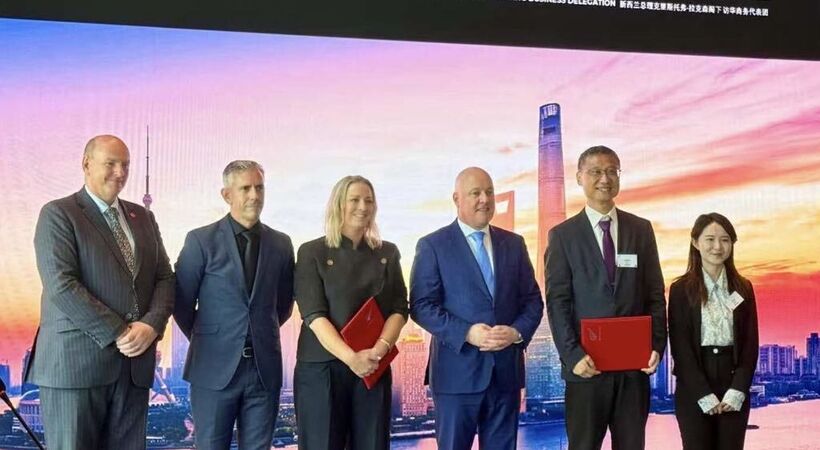
Siemens Energy and EnPot will work together to help decarbonise the aluminium industry in China.
The two companies agreed to cooperate in an official ceremony with New Zealand’s Prime Minister Christopher Luxon in Shanghai earlier today.
The agreement signals the companies’ joint drive to accelerate decarbonisation of the primary aluminium industry in China.
Together, New Zealand-based EnPot and Siemens Energy will offer solutions to enable intelligent energy management and power modulation for aluminium smelters.
New Zealand’s Prime Minister Christopher Luxon said: “This agreement is a great example of a successful collaboration between New Zealand and China based companies and positive step towards decarbonisation and a more sustainable future.
"It’s great to see New Zealand climate tech competing on the world stage to make a real difference in this emissions-intensive sector.”
The companies’ complementary technologies will provide a path for China’s aluminium producers to integrate more renewable energy, improve energy efficiency and reduce operating costs.
Siemens Energy China GM, Transformation of Industry, Qin Zheng said: "Siemens Energy drives the energy transition, advancing green energy adoption across industries.
"EnPot brings core technologies in commercial operation and expertise in aluminium electrolysis.
“Our deep collaboration in smart energy management for aluminium electrolysis combines complementary strengths to accelerate energy efficiency upgrades and low-carbon transformation.
"Together, we will power sustainable development for China’s aluminium industry and beyond."
EnPot CEO Karyna Young said: “We’re proud to collaborate with Siemens Energy in a joint effort to decarbonise the Chinese aluminium industry.
"Siemens Energy are one of the world’s leading energy innovators, making them an excellent fit for EnPot’s deep modulation technology.”
As the world’s largest aluminium producer, accounting for more than 55% of global output, China is driving change in the industry through policy.
This includes a target for renewable energy to power 30% of its aluminium industry by 2027, and emissions standards and capacity caps.
The two companies are committed to driving advancements in energy efficiency and low-carbon transformation for aluminium smelters.
EnPot technology was invented at the pre-eminent Light Metals research Center (LMRC) at Auckland University, New Zealand between 2003 and 2007.
With EnPot, smelters can use up to 30% more or less energy without disturbing the delicate heat balance required to make aluminium.
This new-found flexibility makes smelters more compatible with the variable electricity supply provided by renewable generation.
EnPot is a New Zealand based technology company in commercial operation at the Trimet Smelter in Essen, Germany and installed on a smelter in China.