




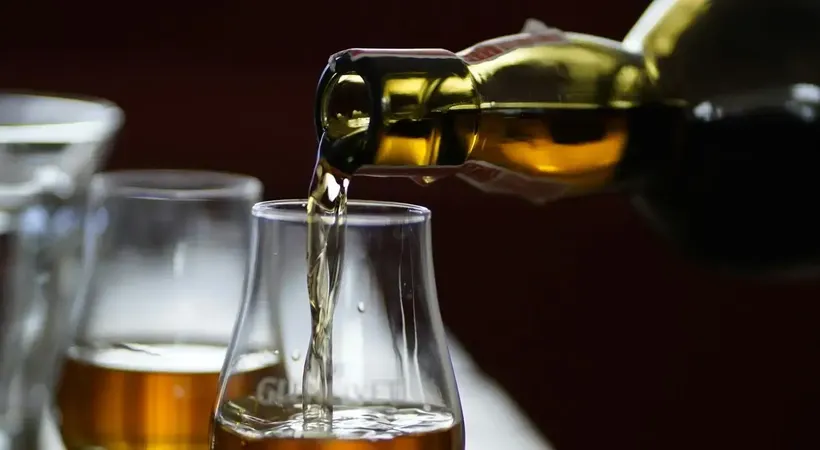
Stirling Distillery is debating the move to aluminium after working with scientists to find out whether the metal could replace glass bottles for its Scotch whisky.
Stirling Distillery is one of Scotland’s smallest distilleries.
Experts from Heriot-Watt University’s School of Engineering and Physical Sciences are working on the project, investigating how whisky behaves when stored in aluminium rather than traditional glass bottles.
Kathryn Holm, Head of Communications & Marketing at Stirling Distillery initiated the project.
Ms Holm stated: “We want to make our distillery as sustainable as possible ahead of our first mature whisky being released in 2027.
“The whisky industry is looking at lots of ways to minimise its footprint. We’ve already undertaken a range of sustainability measures - packaging is one of the remaining areas where we can innovate and make an impact.
“Glass has long been central to whisky’s image; it’s weighty, and evokes the craftsmanship of the spirit. But it is also heavy to transport and relies on high recycling rates to reduce its environmental impact.
“Aluminium is lighter and widely recycled, so I asked the experts to investigate whether it’s a viable alternative.”
At Heriot-Watt, the researchers from the ICBD and Institute of Chemical Sciences combined advanced chemistry with sensory tests to see whether aluminium interacts chemically with whisky in a way that alters its flavour or raises safety concerns.
Dr Dave Ellis and his student, Charlotte York, tested the spirit using nuclear magnetic resonance spectroscopy, a technique that uses a powerful magnet combined with radiofrequency waves to identify what a substance is made of by measuring how its atoms respond, and inductively coupled plasma mass spectrometry, which detects levels of metals in liquids.
The chemistry showed that compounds such as gallic acid, which develop during whisky maturation, were reduced or removed after prolonged contact with aluminium.
Professor Annie Hill from Heriot-Watt’s ICB, added: “Any innovation has to respect the craft of whisky making while meeting the highest standards of safety.
“The aluminium cans we buy pulses and soup in all have liners to protect the contents from metal contamination. In this case the liner within the can wasn’t sufficient to prevent aluminium from passing into the spirit.
“The next stage of this research would be to find a liner that can withstand high alcohol levels for a prolonged period of time without degrading.”
In the taste-test stage, panellists couldn’t distinguish between whisky stored in aluminium from whisky stored in glass.
Ms Holm said the work would be shared with the wider industry, which, like the aluminium industry, is under growing pressure to meet net zero targets.
She concluded: “We are not suggesting glass disappears tomorrow. But offering customers a lower carbon option for a premium product is something worth exploring. As a small distillery, we can help start that conversation.”

