




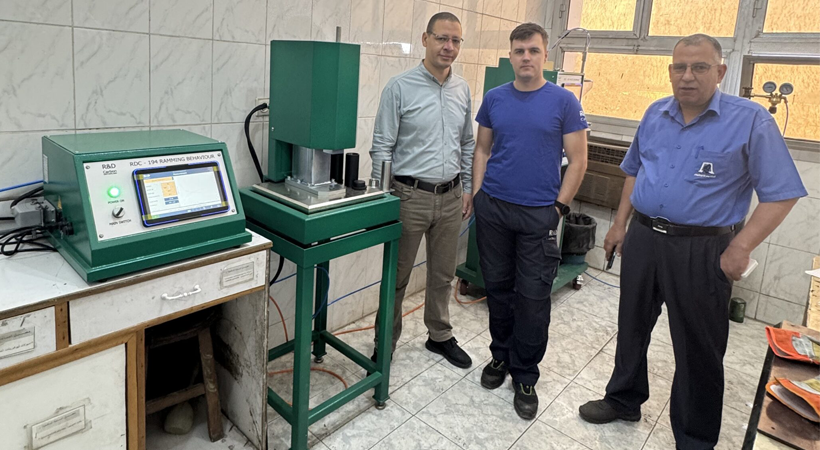
R&D Carbon has commissioned three carbon test equipment units at the Aluminium Company of Egypt (Egyptalum).
The commissioning was carried out as part of Egyptalum’s ongoing commitment to strengthening quality control and laboratory capabilities in carbon anode production.
Egyptalum’s laboratory has been equipped with R&D Carbon test equipment for more than 35 years and continues to upgrade its facilities to maintain high quality levels.
The following equipment was installed and commissioned on site:
- Core Drilling Machine (RDC-157)
- Ramming Behaviour (RDC-194)
- Paste Shrinkage (RDC-195)
The RDC-157 is designed to ensure correct core sampling in carbon electrode quality control, eliminating errors caused by improper drilling methods.
Its controlled, motor‑driven drilling system, with adjustable pressure and speed, ensures the preparation of standardised cores (50 mm diameter, approximately 250 mm length) making test results reliable and comparable.
The RDC-194 determines the optimal ramming temperature window of cathode ramming paste by automatically measuring compaction behaviour at different paste temperatures.
By combining controlled ramming, real‑time height measurement, and integrated software analysis, it ensures reliable paste characterisation and reproducible sample preparation for both density and shrinkage testing (with RDC-195 Paste Shrinkage equipment delivered simultaneously).
The RDC-195 measures the dimensional changes of cathode ramming paste during baking, a critical factor for ensuring long and disturbance‑free cell operation.
The paste cylinder is initially prepared with the RDC-194 apparatus, the automatic ramming device delivered simultaneously to Egyptalum and then baked with the RDC-195 Paste Shrinkage instrument.
By recording paste expansion and shrinkage up to 950 °C under controlled conditions, it accurately determines paste shrinkage as a percentage of the initial sample length.
The commissioning process included equipment installation, calibration, functional testing, and on‑site training of Egyptalum’s laboratory technician and operators.
The training ensured that operators were fully familiar with the operation, preventive maintenance, and interpretation of test results for each unit.
R&D Carbon said the project reflected their strong collaboration with Egyptalum, as well as a shared commitment to advance the best practices in carbon testing and process optimisation.
The company thanked Egyptalum for their trust and co-operation, and said it looked forward to supporting them with testing solutions and technical expertise in the future.

