




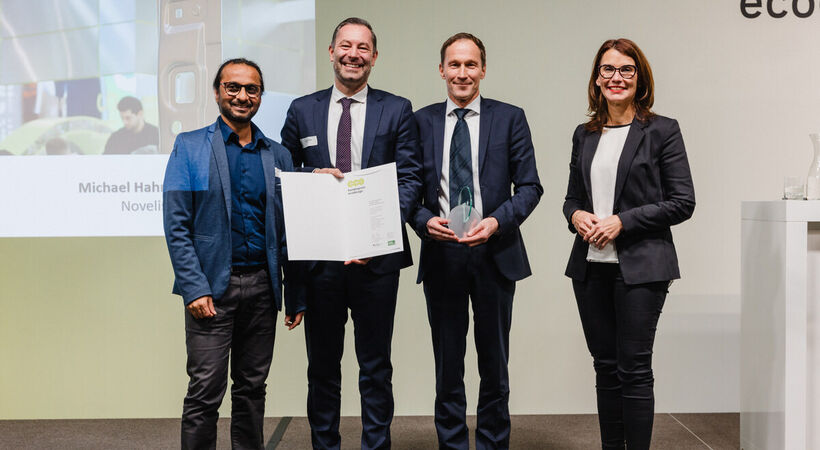
Novelis has been awarded with the 2025 German Ecodesign Award in the “Product” category.
The award recognises a prototype aluminium sheet made with 100% end-of-life vehicle scrap, specifically developed for use in exterior car body applications.
The official award ceremony took place on 1 December 2025 in Berlin, Germany.
The German Ecodesign Award is Germany's highest state award for ecological design, according to its organisers.
The award has been presented since 2012 by the Federal Ministry for the Environment and the German Environment Agency in cooperation with the International Design Center Berlin (IDZ).
It honours pioneering products, services, and concepts that combine design and environmental responsibility in an innovative way.
Novelis’ award-winning product is the result of continuous research and development in close collaboration with partners across the entire automotive value chain.
The alloy Novelis Advanz 6F – e170RC contains at least 75% recycled content, sourced from a mix of pre-consumer vehicle manufacturing scrap and post-consumer aluminium from various end-of-life products.
With the awarded prototype however Novelis achieved 100% recycled content by solely using end-of-life automotive material as a single source of scrap.
This achievement proves that true car-to-car aluminium recycling is technically and economically feasible.
“This award is a recognition of the vision and dedication of our team that made this innovation possible,” said Michael Hahne, Vice President Commercial, Novelis Europe.
“We thank the jury of the German Ecodesign Award for this honour which will further motivate us to deliver more sustainable solutions to the market and strengthen collaboration across the recycling ecosystem.”
As part of its Novelis 3x30 sustainability strategy, the company is actively promoting a fully circular economy to establish product-to-product circularity for aluminium.
Novelis is also continuously increasing the share of end-of-life materials by creating innovative material flows and fostering transparent collaboration across the recycling ecosystem.
This collective approach is essential to secure scalable access to high-quality end-of-life automotive scrap.

