




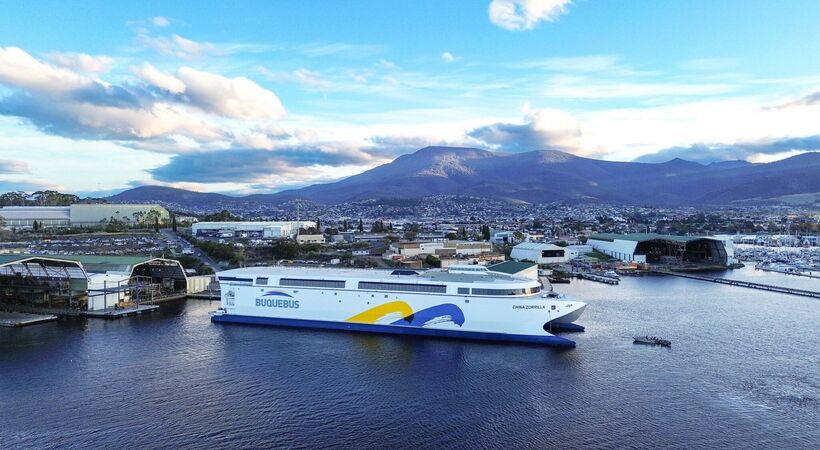
Incat Tasmania is delivering an advanced aluminium electric shipbuilding programme, with five large sustainable aluminium vessels now in its production pipeline.
Incat is a shipbuilder based in Hobart, Tasmania, specialising in sustainable ferries and high-speed catamarans.
All vessels are being built at Incat’s Hobart shipyard – the only large shipyard in the world to operate in a net zero location.
In May this year, Incat launched Hull 096, the world’s largest battery-electric ferry.
The Hull 096 is a 130-metre aluminium catamaran designed to carry 2,100 passengers and 225 vehicles across the River Plate between Argentina and Uruguay, powered entirely by clean energy.
Construction is also advancing on Hulls 100 and 101, a pair of 78-metre hybrid-electric ferries. The ferries are capable of operating in fully electric or hybrid modes to suit diverse service requirements.
“Nowhere else in the world is an aluminium shipyard building such a concentration of large electric and hybrid-electric vessels,” said Incat Chairman Robert Clifford.
“This programme highlights our world-leading innovation and shipbuilding capability, and it’s why major operators are choosing Incat to deliver their future ferry fleets.”
As part of the world’s largest electrification project at sea, Incat will also deliver two 129-metre battery-electric ferries for leading Danish operator Molslinjen. These vessels will be the largest zero emission ferries in Europe.
Incat is also scaling up its workforce and expanding its shipyard capacity to meet growing global demand.
With multiple vessels under construction and a strong pipeline ahead, the company is positioning itself to deliver several sustainable, commercially viable aluminium ferries each year to international operators.
Incat’s programme demonstrates how aluminium shipbuilding can achieve zero-emission goals without compromising speed, reliability, capacity or commercial viability.
