





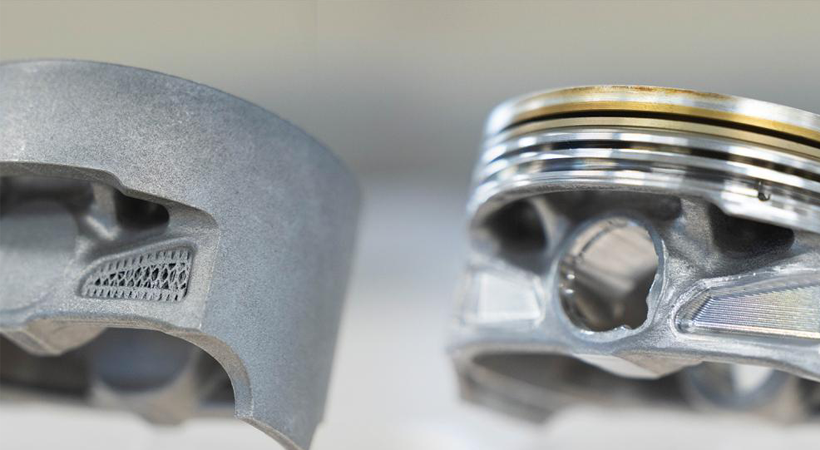
The Oak Ridge National Laboratory (ORNL) in Tennessee, US, has developed a 3D-printable aluminium alloy designed for high-temperature automotive and aerospace applications.
It was developed by a team at the US Department of Energy’s Manufacturing Demonstration Facility at ORNL.
The alloy, called DuAlumin-3D, contains cerium, nickel, and zirconium.
It is resistant to process defects and has a high fraction of heat-resistant, strengthening particles that form at the nanoscale during printing.
These characteristics make the alloy suitable for printing complex geometries such as heat exchangers and pistons.
Critically, the alloy also maintains desired mechanical properties up to 400°C.
It took less than three years to progress from conceptualising DuAlumin-3D to printing full-scale prototype automotive pistons.
It was manufactured at more than 99.9% density and exhibited high creep resistance for a bulk aluminium alloy at 400°C.
Creep resistance is a material’s ability to resist slow, permanent deformation when exposed to heat and stress.

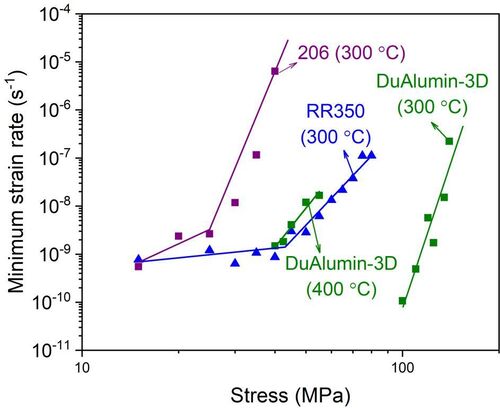
Analysis showed DuAlumin provides the same creep resistance as other commonly used alloys, but at 100°C higher operating temperature. (Credit: ORNL, US Dept. of Energy.)
The alloy also possesses excellent fatigue strength at 350°C, meaning it can withstand repeated cycles of stress over time without breaking.
It is also suitable for use at temperatures approximately 150°C higher than other aluminium alloys.
Furthermore, DuAlumin-3D is half the weight and nearly six times more thermally conductive than titanium.
In aviation, using DuAlumin-3D as a substitute for titanium in heat exchangers can trim hundreds of pounds per aircraft.
If applied to commercial aircraft fleets, this translates to more than 50 million gallons of jet fuel saved annually, which is worth more than $120 million.
The thermal stability and mechanical properties of DuAlumin-3D are also valuable for the design of future ultra-high efficiency, lightweight automotive engines.
Replacing existing aluminium alloys with DuAlumin-3D can increase peak cylinder temperatures by 50–100°C.
Additionally, when combined with the flexibility of Additive Manufacturing (AM), it opens design opportunities that can increase engine thermodynamic efficiency by up to 10%.
Overall, DuAlumin-3D could save the US approximately $3 billion in annual fuel costs if adopted by 10% of the automotive sector.
