




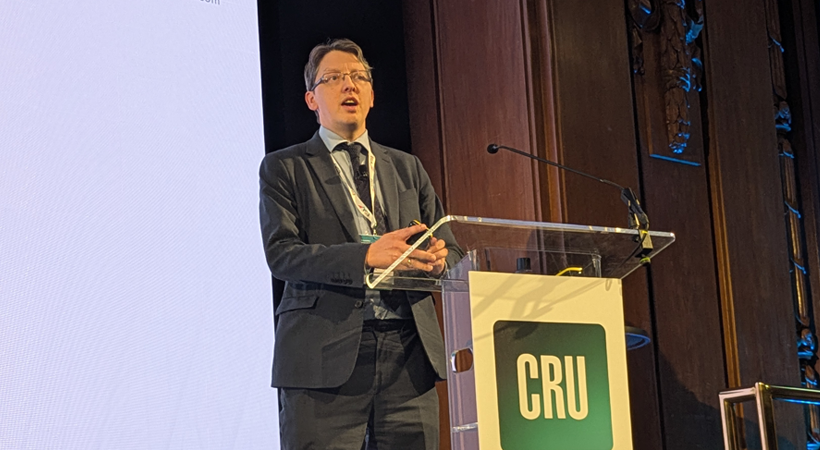
At the recent World Aluminium Summit, Ross Strachan, Head of Aluminium Raw Materials at CRU, outlined the impact of the Middle East conflict on global aluminium production.
He discussed how the crisis had disrupted trade routes and the supply of value-added products (VAPs), while raising the risk of demand destruction.
Reflecting on the situation, Strachan said: “[This] is the most dramatic supply shock the industry has faced.
“Many of us have experienced a number of major demand shocks, but this is, as far as the aluminium industry is concerned, quite unprecedented.”
CRU estimated that by the end of May, approximately 3.4 million tonnes of capacity in the Gulf will have closed.
The conflict has affected the majority of smelters in the Gulf region.
Emirates Global Aluminium’s (EGA) Al Taweelah smelter was forced to temporarily close following an Iranian missile attack, resulting in an annual capacity loss of 1.5 million tonnes.
Meanwhile, the Qatalum smelter (a 50/50 joint venture between Hydro and QAMCO) curtailed its output by around 40% after regional drone attacks disrupted local natural gas supplies.
In addition, Aluminium Bahrain (Alba) initiated a controlled shutdown of Reduction Lines 1, 2, and 3 at its Bahrain smelter because raw materials could not clear the Strait of Hormuz.
Global supply
In Asia, supply volumes have dropped; Japanese and Korean aluminium wheel manufacturers have been forced to reduce production because they cannot source enough Primary Foundry Alloy (PFA) from certified suppliers.
Strachan said that while Asia may have felt these shortages first, the most acute consequences were likely to hit Europe.
The situation is being further exacerbated by the loss of sanctioned Russian material and production halts in Africa, such as the closure of South32’s Mozal smelter in Mozambique earlier this year.
In addition, the Gulf is a key supplier of VAPs, with EGA being a large exporter of both billet and PFA, the Saudi Arabian Mining Company (Ma’aden) exporting considerable quantities of slab, and other regional producers contributing large volumes of specialised products.
However, due to the logistical challenges of shipping material out of the region, several Gulf producers are now prioritising standard ingot over VAPs.
As a result, CRU believes that VAP output is falling faster than ingot production.
Market outlook
Strachan said that if the disruptions persist and the Strait of Hormuz remains closed, Southeast Asian producers will likely adapt to meet the demand for VAPs.
While Indonesia is currently focused on increasing its primary ingot capacity, it is highly likely the country will eventually expand into VAPs, particularly billet, alongside existing regional output from Malaysia.
Other solutions include the growth of secondary capacity, where recycled metal could play a pivotal role in offsetting primary tonnage losses.
For example, Hydro is planning to start up a new recycling facility in Spain later this year.
Furthermore, some industry observers expect China to gain market share and “be the answer” to current supply disruptions, given recent data and anecdotal evidence of rising material flows out of the country.
Meanwhile, others anticipate an increase in Russian material flowing to countries willing to accept it.
Strachan said: “At the moment, we are seeing the biggest loss, of course, within the Middle East itself.
“Those economies have been hit naturally particularly hard.
“But some of the exporting regions, particularly in Southeast Asia, are also taking effect, as well as the broader inflationary consequences flowing through.
“So, this downgrade to demand has softened the impact of some of the supply side cuts that we have seen.
“But the bigger picture is that we are still seeing overall a very large deficit of around 1.4 million tonnes for this year and a market which is supportive of higher prices and higher premiums.”
This reality is most apparent in CRU’s assessments for the European billet premium, which has surged dramatically.
European extruders increasingly fear supply delays and an inability to source enough billet.
CRU warns that if the geopolitical crisis goes on, the billet premium could skyrocket to even more extreme levels and stay there long-term, which would drastically dampen downstream demand over time.
Summary
In summary, Middle Eastern production has plummeted by nearly a third, with remaining operations prioritising ingot over VAPs.
While China and Russia represent the most likely alternative sources for this lost tonnage, the global market will struggle to adjust.
Consequently, aluminium premiums and freight rates are expected to stay elevated for the foreseeable future, particularly while Gulf output remains severely constrained.

